
This article is based on data from the annual Instituto Cervantes "Spanish in the World" report from November 2025. The next figures will be out in November 2026.

Looking for statistics on the number of Spanish speakers in the world?
Below, you’ll find 40 statistics covering the number of Spanish speakers worldwide – plus a breakdown of the populations of native speakers, non-native speakers and language students.
Information has been collected from the Instituto Cervantes, the Spanish Federation of Spanish Language Schools (FEDELE), and Spain's National Institute for Statistics.
The second half of the article features two lists which cover:
The 20 countries (and one self-governing territory) where Spanish is an official language (ranked in order of population)
28 countries where Spanish is not an official language (ranked in order of population of Spanish speakers)
Speakeasy BCN is a leading Spanish language school in Barcelona. We are accredited by the Instituto Cervantes and we are part of FEDELE. If you're interested in learning Spanish yourself, we hope these statistics convince you it's a great choice!
Not sure what level you're at? Take our free online level test – it takes about 10 minutes.
40 statistics about Spanish speakers
Spanish speakers in the world
As of 2025, there are 636 million Spanish speakers worldwide. That's up from 600 million global Spanish speakers recorded in 2024.
Spanish speakers represent 7.6% of the global population.
As of November 2025, the number of Spanish speakers globally is 635,743,644.
There are 519 million native Spanish speakers making up 6.3% of the global population.
Spanish is the world’s third most widely spoken mother tongue, after Mandarin and Hindi.
Native Spanish speakers now outnumber native English speakers – about 519 million to 390 million – which places English fourth among the world's native-speaker communities, behind Mandarin, Hindi and Spanish. Spanish is also the world's most widely spoken Romance language.
There are 127 million Spanish speakers living outside of Spanish-speaking countries – i.e. people who are either native speakers or have learned Spanish.
24.6 million people are studying Spanish worldwide – this is the fastest-growing segment of Spanish speakers globally.
Countries where Spanish is an official language
Spanish is an official language in 20 countries and one self-governing territory (Puerto Rico).
A total of 460 million native Spanish speakers reside in countries or territories where Spanish is an official language.
Mexico is the largest Spanish-speaking country in the world. It has a population of 138 million of which 130 million (94%) are native Spanish speakers. An additional eight million are bilingual in Spanish and one of Mexico's 68 recognized indigenous languages.
Equatorial Guinea is the only Spanish-speaking African country – i.e. a country where Spanish is an official language – with 74% of the population being native speakers.
Equatorial Guinea is also the smallest Spanish-speaking country. It has a population of 1.7 million of which 1.2 million (74%) are native Spanish speakers, and a further 437,000 are fluent in Spanish.
The economies of Spanish-speaking nations account for nearly 7% of the global economy.
Countries where Spanish is not an official language
Almost 60 million native Spanish speakers live in non Spanish-speaking countries – i.e. a country where Spanish is not an official language.
More than 67 million non-native Spanish speakers live in non Spanish-speaking countries – i.e. they learned Spanish later in life or were raised in a bilingual area where Spanish was not their mother tongue.
A total of 127 million Spanish speakers live in countries where Spanish is not an official language. This figure includes both native Spanish speakers and people who speak Spanish but it's not their mother tongue.
In 2015, the number of Spanish speakers in the USA surpassed the entire population of Spain for the first time. Today, the United States has second-largest population of Spanish speakers, with 45.5 million native Spanish speakers and 20 million non-native speakers – a total of 65.5 million.
Spanish is spoken at home by 13.3% of the U.S. population aged five and over.
The Philippines is the country with the largest population of Spanish speakers in Asia, totalling 554,000. This is due to the country being a former colony of Spain.
Morocco has the largest population of Spanish speakers in Africa, with 1.9 million people (native and non-native). Morocco is the closest African country geographically to Spain, and there are two Spanish enclaves on the coast of the north-african country: Ceuta and Melilla.
Excluding Spain, Switzerland is the European country with the highest number of Spanish speakers, totaling 565,000.
In Oceania, Australia has the highest number of Spanish speakers, at 560,000.
The former Netherlands Antilles has one of the largest Spanish-speaking populations among Caribbean territories where Spanish is not an official language, with 177,000 speakers. The islands that make up the so-called Dutch Caribbean are either municipalities of the Kingdom of the Netherlands or constituent countries, so the official language is Dutch.
Spanish in the arts (and on the Internet)
Spanish is the sixth-largest language by publishing output, with around 7% of all books published worldwide being in Spanish.
Spanish is the second most prolific language in film production, after English
In 2023, around a quarter of the songs on the hit lists of platforms like Spotify and YouTube were in Spanish.
Spanish ranks as the sixth most translated language globally, following English, French, German, Russian, and Italian.
Spanish is the second most common language for website content, after English, accounting for around 6% of all websites.
Gabriel García Márquez is the most translated Spanish-language author of the 21st century, with 1,382 translations of his works.
After English, Spanish is the language with the most Netflix-produced series, totalling 88 in 2021.
Spanish language students across the world
The United States, the European Union, and Brazil account for four out of five Spanish language students worldwide – roughly 80%. This is due to Spanish being a common foreign language taught at elementary and secondary schools.
The United States has the highest number of Spanish language students, with 8.9 million enrolled – 8.4 million in schools, 585,000 at universities, and 3,700 in private institutions.
Outside of Spain, France leads Europe with 3.6 million Spanish language students – 3.4 million in schools, 244,000 at universities, and 9,000 in private institutions.
Ivory Coast has the largest number of Spanish students in Africa, with 798,000 enrolled – 795,000 in schools and 1,800 at universities.
Australia has the highest number of Spanish students in Oceania, with 63,000 enrolled – 53,000 in schools, 9,300 at universities, and 800 in private institutions.
Japan has the highest number of Spanish students in Asia, with around 60,000 enrolled. China is second, with 54,000 - 9,000 in schools, 35,000 at universities, and around 10,000 in other settings.
Spain is the country with the most active students either studying the Spanish language or studying other courses with Spanish as the medium of tuition. There are more than 530,000 non-native Spanish speakers studying in Spain – with 98,000 international university students and over 421,000 studying at more than 400 Spanish language schools.
Madrid is the Spanish city that hosts the most foreign students at private Spanish-language schools, with Barcelona close behind. According to the FEDELE association of Spanish language schools, Madrid hosted 15,118 students in 2024 and Barcelona 14,782.
Language and culture are a genuine draw: a significant share of visitors to Spain cite experiencing the culture and practising the language among their reasons for travelling.
With Barcelona one of the top cities in Spain to study the language, second only to Madrid, there's never been a better moment to join them. If these numbers have you tempted, our intensive Spanish courses get you fluent fast, while our long-term courses in Barcelona suit anyone settling into the city for the longer haul.
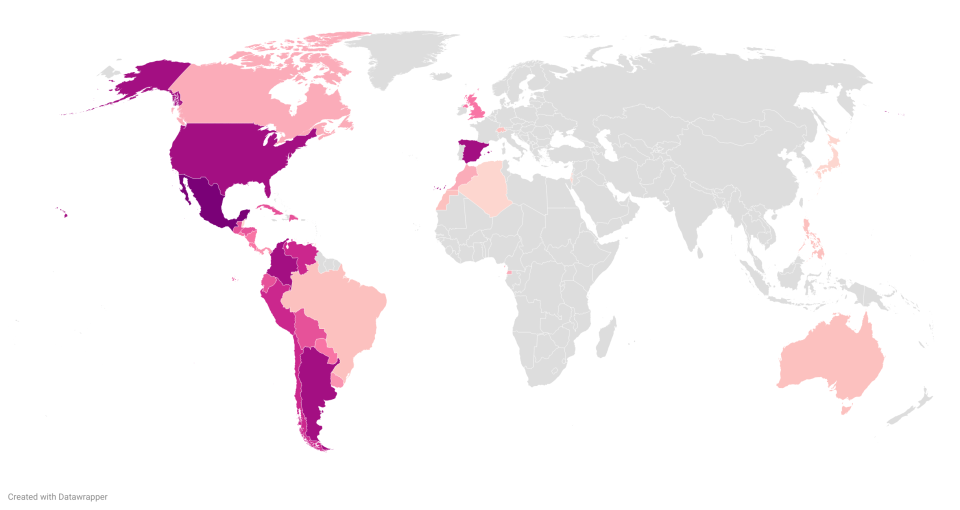
Lists of top Spanish-speaking countries in the world
Countries and territories where Spanish is an official language
Below you’ll find a list of the 20 countries and one self-governing territory (Puerto Rico) where Spanish is an official language.
The countries are ordered by population size.
You’ll also find the latest figures on the number of native Spanish-speaking citizens per country and territory.
Mexico
Population: 138 million
Fluent Spanish speakers: 138 million (99.9%)
Native Spanish speakers: 130 million (94%)Colombia
Population: 53 million
Fluent Spanish speakers: 53 million (100%)
Native Spanish speakers: 52 million (98%)Spain
Population: 49 million
Fluent Spanish speakers: 49 million (99.3%)
Native Spanish speakers: 47 million (96%)Argentina
Population: 47.5 million
Fluent Spanish speakers: 47 million (100%)
Native Spanish speakers: 47 million (98.7%)Peru
Population: 34.4 million
Fluent Spanish speakers: 30.6 million (88.9%)
Native Spanish speakers: 29.6 million (86%)Venezuela
Population: 29.4 million
Fluent Spanish speakers: 29.4 million (100%)
Native Spanish speakers: 28.6 million (97%)Chile
Population: 20.2 million
Fluent Spanish speakers: 20.2 million (100%)
Native Spanish speakers: 19.3 million (96%)Ecuador
Population: 18.1 million
Fluent Spanish speakers: 17.6 million (96.8%)
Native Spanish speakers: 17 million (94%)Guatemala
Population: 18.1 million
Fluent Spanish speakers: 18 million (94%)
Native Spanish speakers: 13.7 million (76%)Bolivia
Population: 11.4 million
Fluent Spanish speakers: 11.2 million (98.7%)
Native Spanish speakers: 9.2 million (81%)Dominican Republic
Population: 10.9 million
Fluent Spanish speakers: 10.9 million (100%)
Native Spanish speakers: 10.3 million (95%)Cuba
Population: 10 million
Fluent Spanish speakers: 10 million (99%)
Native Spanish speakers: 10 million (99%)Honduras
Population: 10 million
Fluent Spanish speakers: 10 million (100%)
Native Spanish speakers: 9.5 million (95%)Paraguay
Population: 7.8 million
Fluent Spanish speakers: 7.7 million (99%)
Native Spanish speakers: 5.2 million (67%)Nicaragua
Population: 7.2 million
Fluent Spanish speakers: 7.2 million (100%)
Native Spanish speakers: 7 million (97%)El Salvador
Population: 6.4 million
Fluent Spanish speakers: 6.4 million (100%)
Native Spanish speakers: 6.4 million (100%)Costa Rica
Population: 5.6 million
Fluent Spanish speakers: 5.6 million (100%)
Native Spanish speakers: 5.5 million (99%)Panama
Population: 4.5 million
Fluent Spanish speakers: 4.5 million (99%)
Native Spanish speakers: 3.9 million (86%)Uruguay
Population: 3.6 million
Fluent Spanish speakers: 3.6 million (100%)
Native Spanish speakers: 3.6 million (99%)Puerto Rico
Population: 3 million
Fluent Spanish speakers: 3 million (100%)
Native Spanish speakers: 2.8 million (95%)Equatorial Guinea
Population: 1.7 million
Fluent Spanish speakers: 1.7 million (100%)
Native Spanish speakers: 1.2 million (74%)

Countries and territories where Spanish is not an official language
Below you’ll find a list of 28 countries and territories where Spanish is not an official language, but there is a significant Spanish-speaking resident population.
The countries are ordered by size of resident Spanish speakers.
You’ll also find the latest figures on numbers of native and non-native Spanish-speaking citizens. These figures are from the Instituto Cervantes and 'non-native' refers to people who are either fluent in Spanish or studied Spanish at high school or college (or the country's equivalent).
Here's the list:
United States
Total Spanish speakers: 65.5 million
Native speakers: 45.5 million
Non-native speakers: 20 millionEuropean Union (EU-27) not including Spain
Total Spanish speakers: 45.8 million
Native speakers: 11.3 million
Non-native speakers: 34.3 millionUnited Kingdom
Total Spanish speakers: 5.8 million
Native speakers: 218,000
Non-native speakers: 5.6 millionBrazil
Total Spanish speakers: 3 million
Native speakers: 1.1 million
Non-native speakers: 1.9 millionMorocco
Total Spanish speakers: 1.9 million
Native speakers: 137,000
Non-native speakers: 1.8 millionCanada
Total Spanish speakers: 1.4 million
Native speakers: 321,000
Non-native speakers: 1 millionAustralia
Total Spanish speakers: 572,000
Native speakers: 185,000
Non-native speakers: 387,000Switzerland
Total Spanish speakers: 565,000
Native speakers: 214,000
Non-native speakers: 351,000Philippines
Total Spanish speakers: 554,000
Native speakers: 6,800
Non-native speakers: 548,000Israel
Total Spanish speakers: 440,000
Native speakers: 80,000
Non-native speakers: 360,000Belize
Total Spanish speakers: 238,000
Native speakers: 39,000
Non-native speakers: 199,000Russia, Belarus, Kazakhstan and Kyrgyzstan
Total Spanish speakers: 209,000
Native speakers: 56,000
Non-native speakers: 154,000Dutch Antilles
Total Spanish speakers: 177,000
Native speakers: 37,000
Non-native speakers: 141,000Algeria
Total Spanish speakers: 177,000
Native speakers: 1,000
Non-native speakers: 174,000Trinidad and Tobago
Total Spanish speakers: 117,000
Native speakers: 49,000
Non-native speakers: 68,000Aruba
Total Spanish speakers: 96,000
Native speakers: 18,000
Non-native speakers: 78,000Japan
Total Spanish speakers: 91,000
Native speakers: 74,000
Non-native speakers: 17,000Andorra
Total Spanish speakers: 74,000
Native speakers: 35,000
Non-native speakers: 39,000Guam and Northern Mariana Islands (United States)
Total Spanish speakers: 42,000
Native speakers: N/A
Non-native speakers: 42,000China
Total Spanish speakers: 32,000
Native speakers: 20,000
Non-native speakers: 12,000Norway
Total Spanish speakers: 31,000
Native speakers: 27,000
Non-native speakers: 4,000New Zealand
Total Spanish speakers: 28,000
Native speakers: 28,000
Non-native speakers: N/AIceland
Total Spanish speakers: 22,500
Native speakers: 3,000
Non-native speakers: 19,500
Moldova
Total Spanish speakers: 16,000
Native speakers: 11,000
Non-native speakers: 5,000South Korea
Total Spanish speakers: 14,000
Native speakers: 4,000
Non-native speakers: 10,000Turkey
Total Spanish speakers: 12,000
Native speakers: 7,000
Non-native speakers: 5,000India
Total Spanish speakers: 11,000
Native speakers: 7,500
Non-native speakers: 3,500Jamaica
Total Spanish speakers: 9,000
Native speakers: 8,500
Non-native speakers: N/A
There are a further 330,000 native Spanish speakers residing in countries not featured in either of these lists.
Why are there Spanish speakers in countries where Spanish isn't an official language?
The reasons vary from country to country.
Some of the countries below have large Spanish-speaking populations as a result of immigration from Spanish-speaking nations (such as the United States and the United Kingdom).
Others have a large population due to proximity to Spanish-speaking nations (such as Morocco or Brazil).
Other countries and territories have large populations of native and bilingual Spanish speakers without Spanish being an official language (such as in Belize and the Dutch Antilles).
Other nations have large numbers of Spanish speakers due to Spain being a former colonial power (such as the Philippines).
Meanwhile, other nations have large populations of non-native speakers who have studied Spanish at schools or universities (such as the United States, the EU, Canada and Australia).
The way Spanish itself shifts from one country to the next – in accent, vocabulary and slang – is a fascinating topic in its own right. For more, read our guide to the differences between Spanish in Spain and Latin America.
Frequently Asked Questions
How many Spanish speakers are there in the world?
According to the latest Spanish in the World 2025 report by the Instituto Cervantes, there are 636 million Spanish speakers worldwide. It's the first time in history the number of Spanish speakers has reached 636 million. The figure includes 519 million native speakers, 92 million people fluent in Spanish as a second or third language, and 24 million actively studying Spanish.
What percentage of the world speaks Spanish?
Spanish speakers account for 7.6% of the global population. Meanwhile, solely native Spanish speakers represent 6.3% of the world’s population, making Spanish the third most widely spoken language globally after Mandarin and Hindi. These are the latest figures according to the Spanish in the World 2025 report by the Instituto Cervantes. The previous report also found the number of native and non-native Spanish speakers crossed the 600 million mark for the first time in 2024.
Which Asian country has the most Spanish speakers?
The Philippines is the Asian country with the largest population of Spanish speakers with a total number of 554,000, according to the Spanish in the World 2025 report by the Instituto Cervantes. While only 6,800 are native speakers, 548,000 can speak Spanish as a second or third language, reflecting the enduring linguistic and cultural legacy of Spanish colonization.
Which country has the most Spanish speakers?
Mexico is the largest Spanish-speaking country in the world, with a population over 138 million. Of these 138 million, 130 million are native Spanish speakers with an additional eight million being fluent in Spanish but having one of Mexico's 68 indigenous language as their mother tongue – this is according to the latest figures from the Spanish in the World 2025 report released by the Instituto Cervantes.
Ready to join the 636 million?
Spanish is the world's third most spoken language and the fastest-growing one to learn – and you can pick it up right here in Barcelona, one of the top cities in the world for Spanish students.
Many of our students learn Spanish to open up study and work opportunities, and some go on to earn an official qualification with our DELE exam preparation and SIELE exam and preparation courses. Whatever your goal, browse all our Spanish courses to find the right pace, or take our free online level test to see where you'd start.
Learn and improve your Spanish in Barcelona, one of the world's most vibrant and exciting cities.
Here at Speakeasy BCN you'll find courses for all abilities and timetables, an incredible team of talented and motivated teachers and classmates to share your interests and passions. And if you need a visa for your stay, then of course we're able to help and advise.

Start your learning Spanish in Barcelona adventure
Let us know if you have any questions about our courses, our school and life at Speakeasy.